You arrive in the afternoon, from the Tizi n'Tichka or from the airport, and the first real question is not which kasbah to see. It is what you are going to eat tonight, and how things work here. This guide answers the questions our guests ask in their first hour, roughly in the order they ask them. Each section points to a longer article if you want the detail.
When do people eat?
At home, breakfast is bread, olive oil, honey, sometimes eggs, and always tea. Lunch is traditionally the main meal of the day, eaten in the early afternoon. Dinner in families comes late and is often lighter: a soup, bread, what is left from lunch.
Restaurants that cook for travellers keep a different clock. Most kitchens around Ouarzazate serve dinner from about 6 or 7 pm and slow down around 10 pm. After that the choice shrinks quickly, and in the villages outside town it disappears. If you like to eat late, say so when you book. We describe how a typical evening unfolds in our note on having dinner in Ouarzazate.
Do I need to book?
In the centre, for a simple meal, often not. For the tables that cook to order, almost always. A tagine needs well over an hour in clay, a couscous is steamed in several passes, and a small kitchen shops and prepares for the number of people it expects. Booking is not a formality here: it is what allows the food to exist.
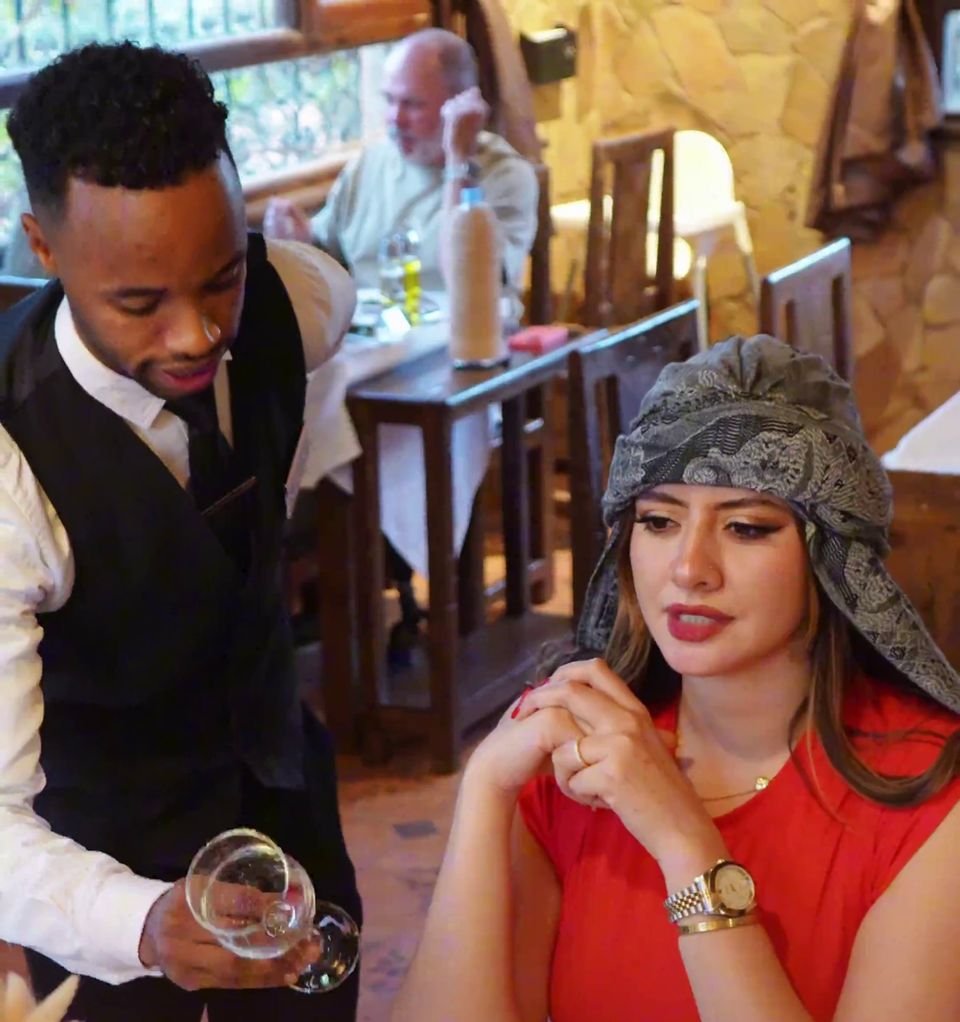
At La Table du Berbère, our own restaurant, dinner is by reservation only, every evening from 6 to 10 pm, and the menu takes about an hour and a half to prepare once ordered. In high season (April to October) and at weekends, book a day or two ahead; groups of more than eight should give a week's notice. The reservation page lets you choose your dishes at the same time.
What does a Moroccan meal look like?
The order hardly changes. Tea or water first. Then salads, cooked and raw, or a soup. Then one large dish: tagine, couscous, rfissa or pastilla. Then fruit, very often oranges, or a few small pastries. Then tea again.
A place that cooks seriously rarely has twenty mains on the menu. A short carte, sometimes a single set menu, is a good sign rather than a lack of choice. We wrote a checklist for spotting an authentic Moroccan restaurant, and a description of a Berber dinner from the first glass of tea to the last.
Sharing, bread and the right hand
The big dishes are made to be shared. A couscous arrives as a dome on a round platter, and everyone eats from the part in front of them, from the edge towards the centre. You do not reach across for the best piece of meat; the host will usually push it towards you.
Bread, khobz, is the cutlery for a tagine. Tear a small piece with the right hand, pinch the meat or vegetables with it, mop the sauce. The left hand stays away from the shared dish. Nobody expects a visitor to get this right, and restaurants put cutlery on the table, but the gesture is noticed. Bread is treated with respect: it is not thrown away or left on the floor.
Tea
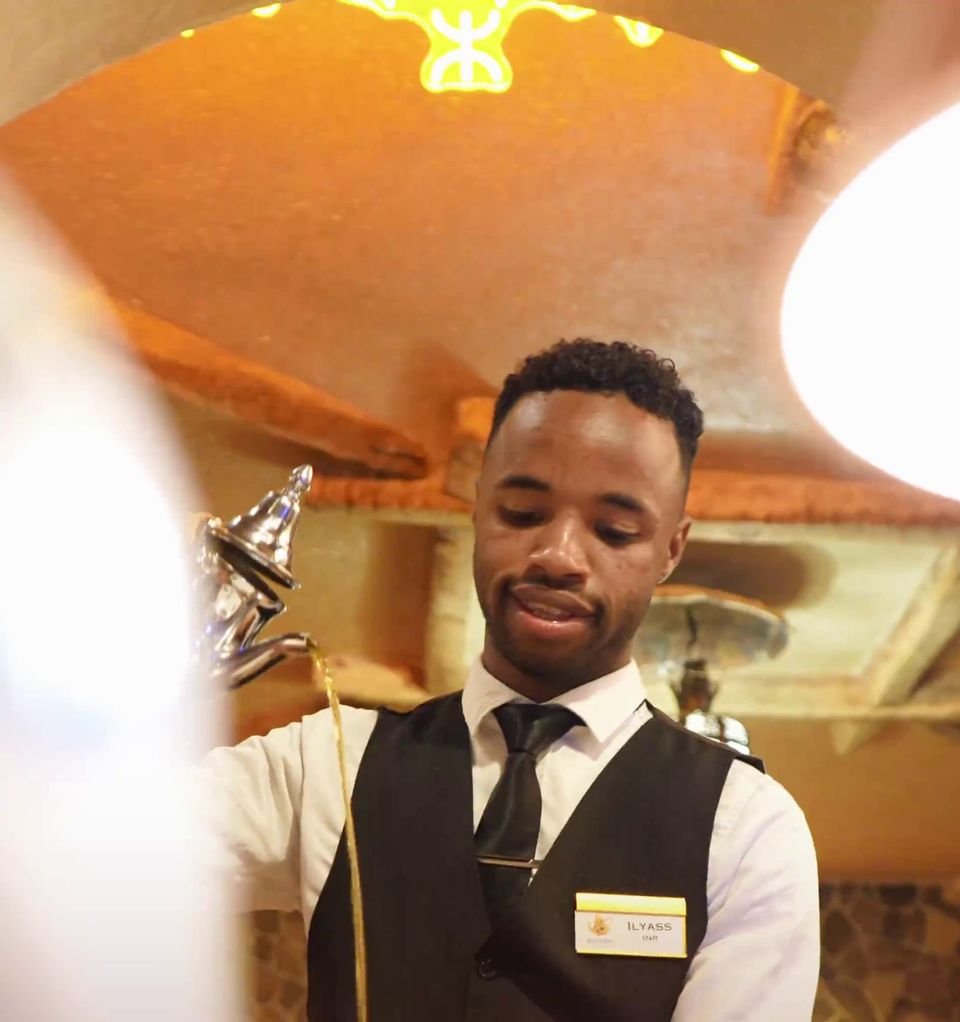
Mint tea is not something you order at the end. It is how a meal begins, how it ends, and how any visit to a house starts. Green tea, a handful of fresh mint, sugar, poured from a height so it foams. You will be offered more than one glass, and accepting at least one is polite. Our article on mint tea in southern Morocco covers the preparation and the habits around it.
Tagine and couscous
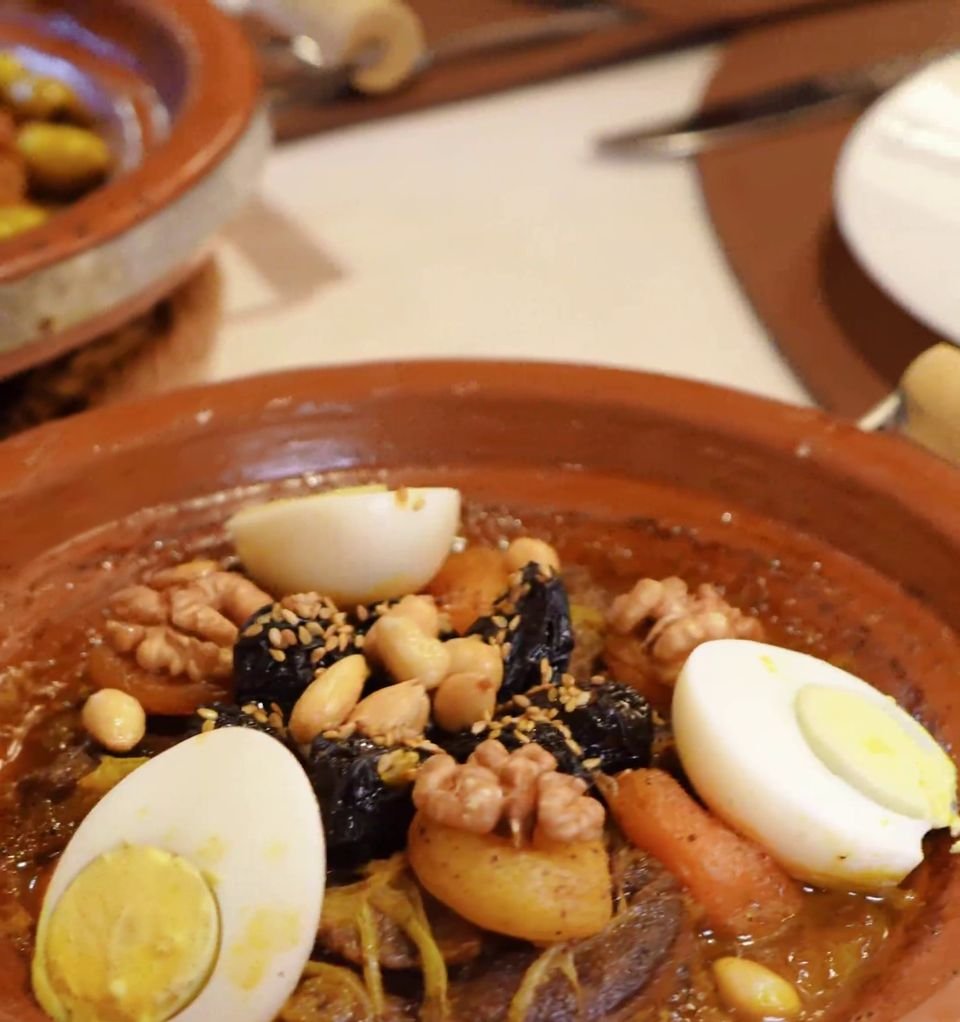
These are the two dishes everyone comes for, and the two most often done badly. A tagine served ten minutes after you order it has been reheated. A good one arrives covered and steaming, and the lid comes off at the table. To know which version to order in this region, and how to judge a kitchen before you sit down, read where to find a good tagine in Ouarzazate.
Couscous is the Friday dish in families, but a restaurant that prepares it properly will make it any evening if you order ahead. See where to eat couscous in Ouarzazate, and for the tradition itself, Friday couscous.
Starters and desserts
Do not skip the salads. A spread of small cooked and raw salads is one of the best things on a Moroccan table: smoky aubergine, peppers and tomato, carrots with cumin, tomato and cucumber. Our guide to Moroccan salads names the ones you will meet. Desserts are simpler than visitors expect, often just fruit; we separated what you will find in the region from what is on our own carte in Moroccan desserts to try.
Eating vegetarian
Easier than its reputation suggests. Salads, vegetable tagine, seven vegetable couscous, soups and nearly every dessert can be meat free. The two traps are broth, since couscous and harira are often cooked with meat stock, and the idea that "with vegetables" means vegetarian. Ask clearly and say it when you book. Practical advice for travellers is in vegetarian food in Ouarzazate.
Where are the different kinds of tables?
- The town centre. Around Kasbah Taourirt, Avenue Mohammed V and Place Al Mouahidine: cafés, juice stalls, restaurants with long menus. Practical at lunchtime and if you sleep in town. See where to eat near Kasbah Taourirt.
- The villages and guesthouses. Tifoultoute, Fint, Skoura, Aït Ben Haddou: short menus, cooking to order, booking needed. This is usually where the food of the region is cooked the way families cook it. Our own village is described in Tifoultoute: the kasbah and where to eat.
- Hotels. The larger hotels welcome non residents, with more formal service. Useful for groups.
- Terraces and rooftops. Lovely at sunset in spring and autumn, colder than you think on winter nights. See rooftop restaurants in Ouarzazate.
Planning dinner around sightseeing
Days here are organised around the light. Aït Ben Haddou and the kasbahs are best early or late, and the studios fill the middle of the day. So you often finish at dusk, tired and hungry, some distance from where you will eat. Book dinner in the morning, give an arrival time, and send a message if you are running late.
A few combinations we suggest to guests:
- After a day at the ksar: dinner after Aït Ben Haddou.
- After the film sets: where to eat near Atlas Studios.
- After an afternoon among the palms: dinner after the Fint oasis.
- The night before a long drive south or east: eating in Ouarzazate before the desert.
Particular evenings
Travelling as a couple, with children, in a group or for a birthday changes what you need from a restaurant: a quiet table, a high chair, a long table and menus ordered in advance, a word to the kitchen. We wrote a separate note for each: a romantic dinner, eating out as a family, group dinners and birthdays and celebrations.
About this guide
This journal belongs to La Table du Berbère, so we are not neutral, and wherever we mention our own table we say so. The advice on how eating works here holds wherever you sit down. If you want to see what we cook, the menu is online.